American Italic 2 med resAmerican Italic 1 med res
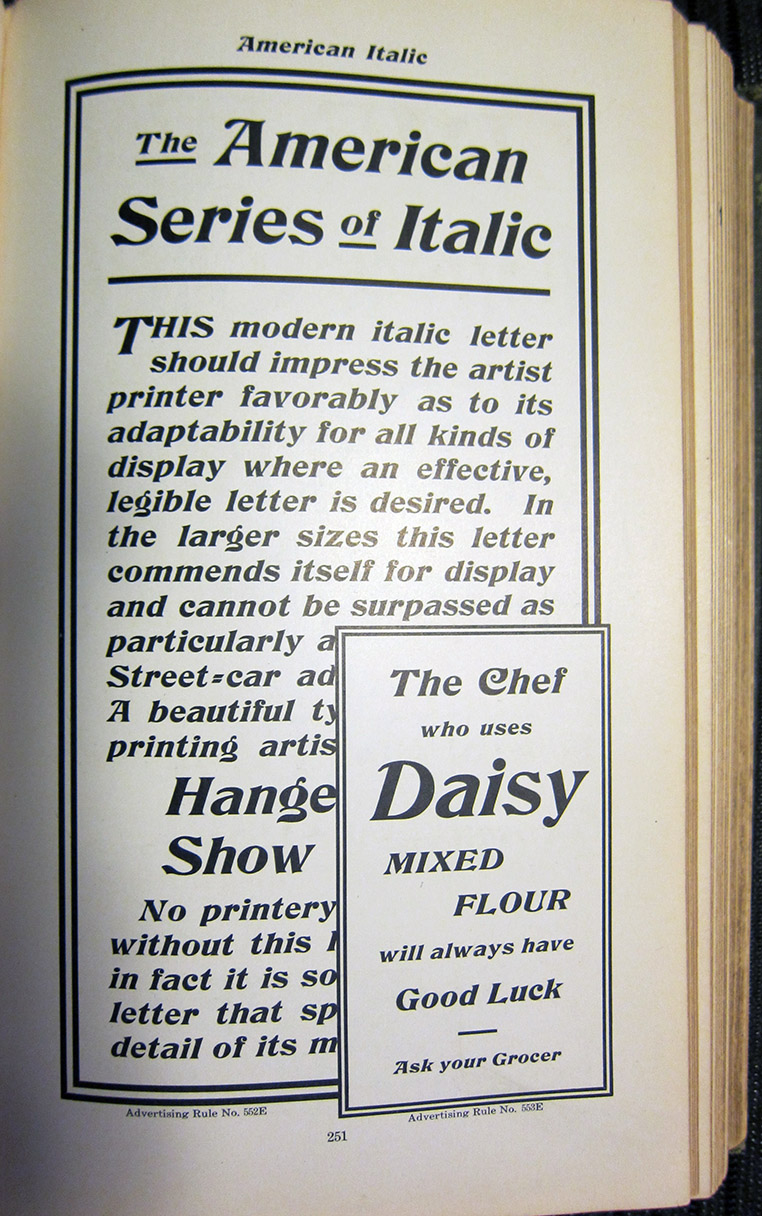
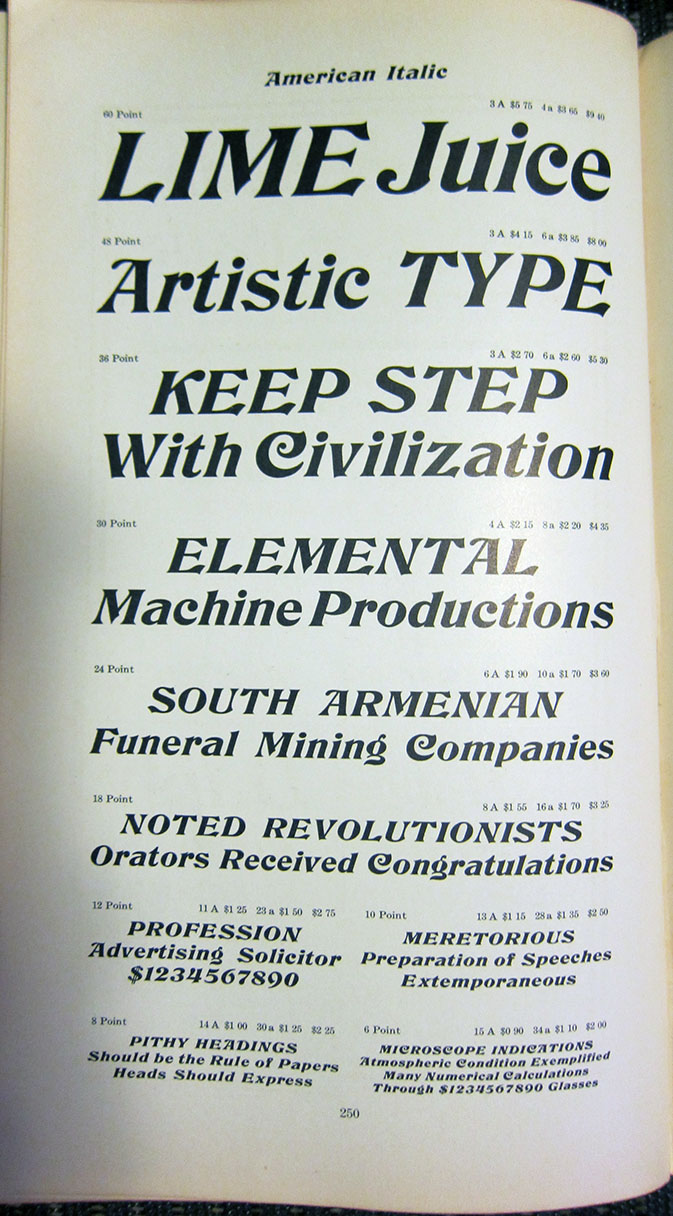
As mentioned previously, I’m working on a revival of the Hermann Ihlenburg typeface Columbus (1892, MacKellar, Smiths & Jordan / American Type Founders), under the name Cristoforo. But now I’m looking for samples of its differently-named italic companion, American Italic (Hermann Ihlenburg, American Type Founders, 1902). I have two from the ATF 1906 specimen book, shown at right. But neither shows a complete character set at a reasonable size. If anyone has the actual metal typeface, especially in a medium to large size, I would love to get a full specimen. Or, if you have a printed sample showing all or most characters at a largish size, that would also be great!
[Update April 21/22: Just got some great pics from Jackson Cavanaugh (Okay Type), showing the relevant pages from the ATF 1899, 1900, and 1903 specimen books! Amelia Hugill-Fontanel at the Cary Library is also digging into it. I am still thinking about scans, but the pics are a fab start. I am already in good shape for Columbus Initials, the swash caps font. I’d love to hear from anybody who has metal type for any of these faces!]
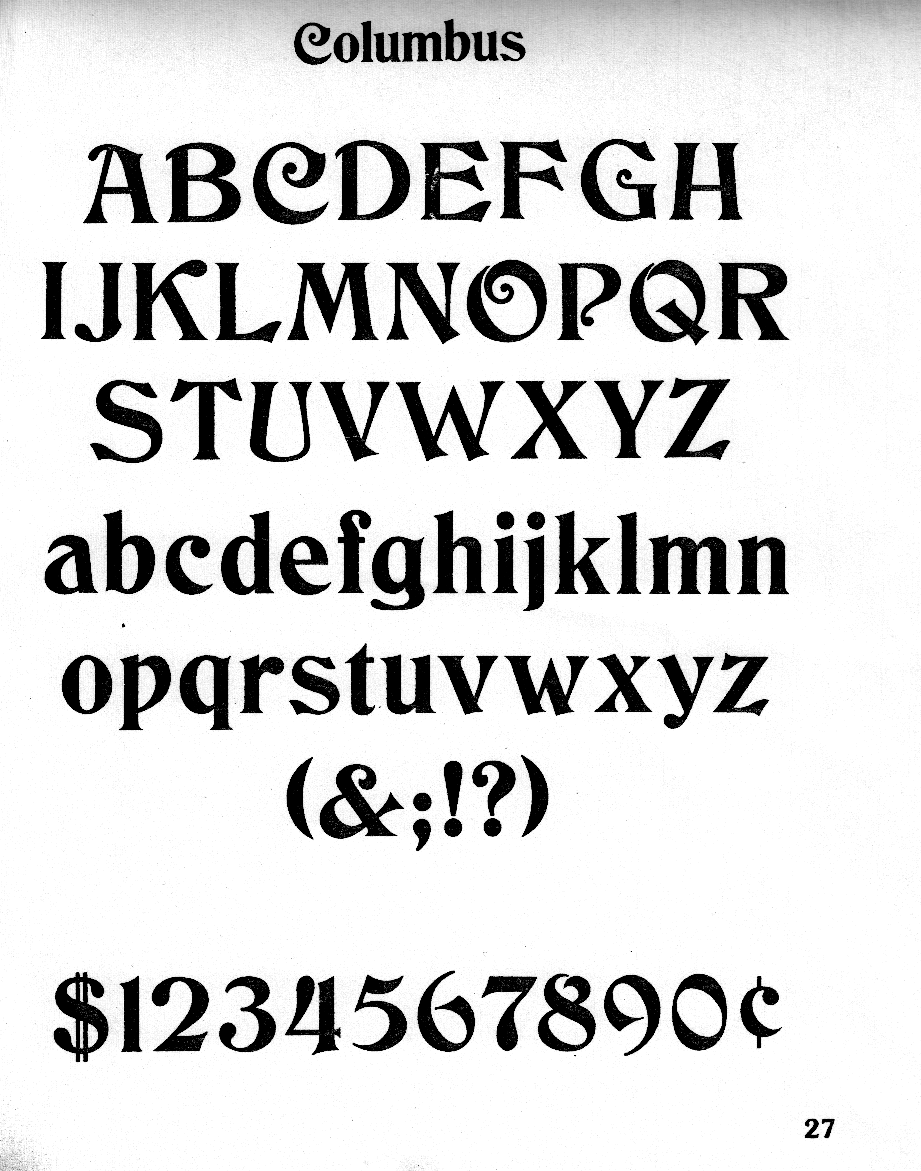
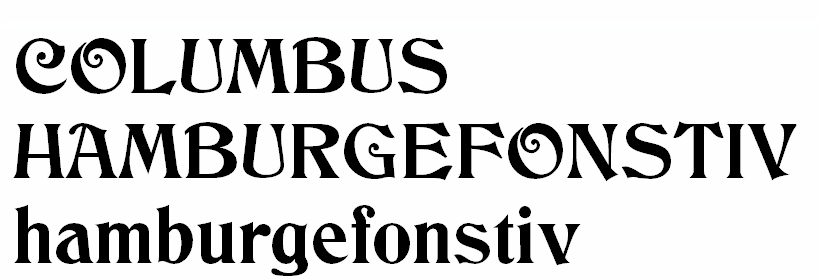
Columbus charset showing
I’m already in decent shape for a sample of the upright version of Columbus, unless it turns out the full typeface has more characters?
Click on any image for a larger version.
Watch this space for news on the related Kickstarter campaign coming in a few days! Get in touch if you would like a sneak preview.[UPDATE 23 April 2012: I am now funding development of this typeface on Kickstarter! Deadline is May 19.]
Sometimes printing a PDF is legal, but making a really pretty book might not be.
I just want to make pretty hand-made hardcover books, like these I did years ago:
Some of my hand-bound hardcovers
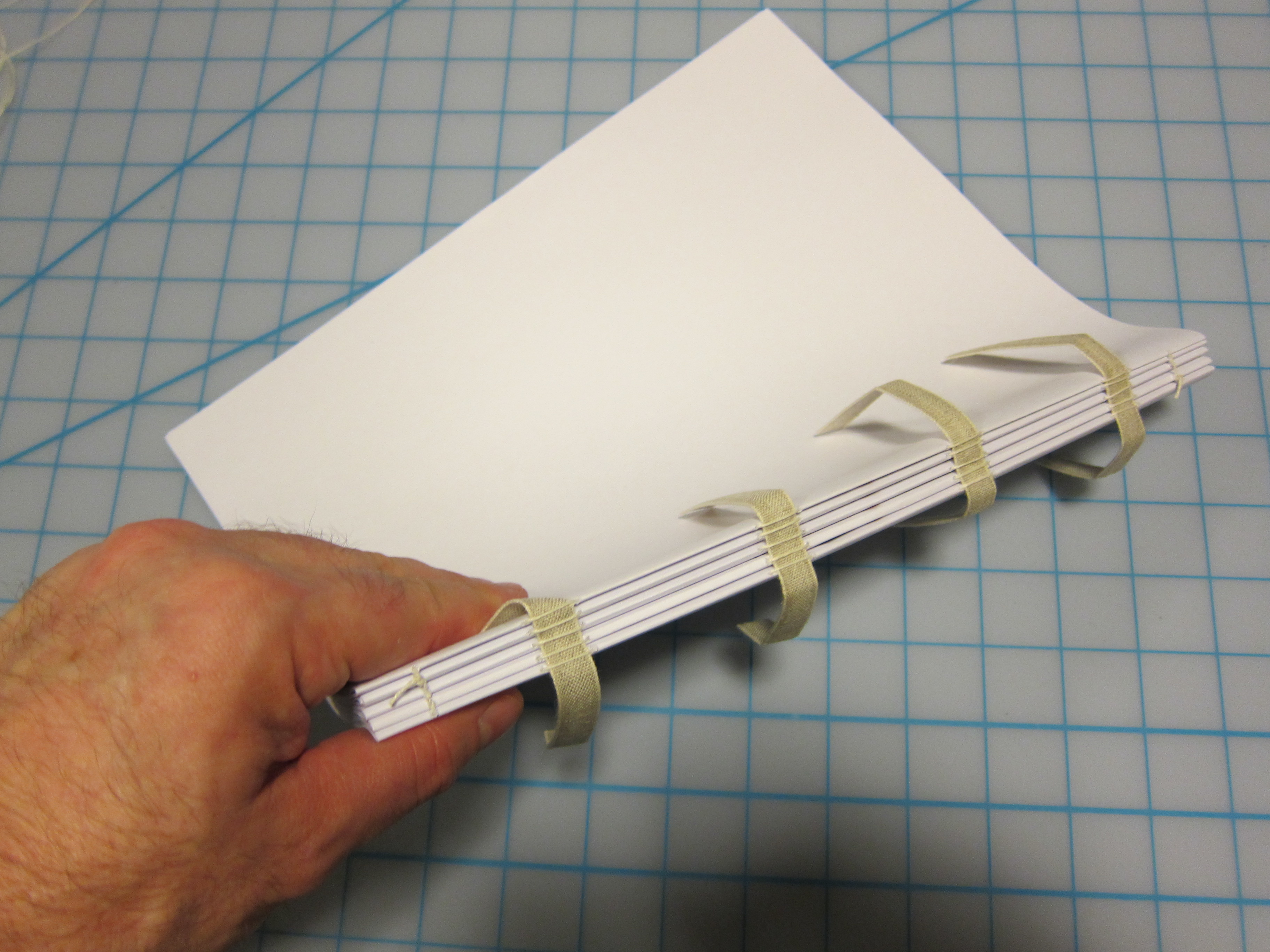
Using real sewn signatures like these:
Sewn signatures ready to bind into a hardcover book (click to enlarge)
Without becoming a criminal.
I’m trying to make some one-off fancy hardcover books from some PDFs I have. Unfortunately, doing so may often be illegal, even when printing the document to make a less nicely bound book would be legal.
“What the heck,” you say? Well, here’s the thing….
Making a really high end hardcover from a document such as a PDF involves rearranging the pages (“imposition”) in order to print them in sets on sheets with more than one page per side, so that you can fold them and sew them in groups (“signatures”).
Commercial e-books sold as PDFs are often encrypted with flags on the PDF permit printing, but not modification. Nor do they permit “document assembly” which is exactly what I need: the ability to rearrange, add and delete pages in the PDF. Unfortunately, common approaches to doing imposition involve generating a modified PDF: one in which the pages are at least rearranged and put more than one to a (now larger) page. So far, it looks like many (perhaps all?) imposition apps do it this way and don’t work with PDFs that have restrictions on modification (perhaps on PDFs that have *any* access restrictions?).
Now, I can easily break the encryption on a PDF, if that PDF allows opening but just has restrictions on specific uses like modification. If I do that, I can then use imposition software on a PDF that allows printing but not modification, and make a fancy book.
But (at least as I understand it, and admittedly I’m not a lawyer) the Digital Millenium Copyright Act says that circumventing an access restriction is always illegal, regardless of why I do it. That makes me a criminal if I do that, even if for the sole reason of making a pretty hardcover book. Even when printing the pages out normally and slapping glue on the spine, like a typical softcover “perfect-bound” book, is permitted and legal.
(Perhaps a lawyer could successfully argue that the flags on PDFs that allow some uses but not others are guidance, rather than effective technological measures creating access restrictions? That is, unlike encryption of the entire PDF with a password needed to open it. That argument worked for Adobe v Monotype over the embedding flags in fonts. But I have neither the interest nor the deep pockets needed to fund making that argument in court.)
[Update: As seen in the comments on this post in the first 18 hours, the legal situation is more complicated and more uncertain than I thought. Fair use may indeed offer a defense. Given the uncertainty, and my desire to stay on the right side of both copyright law and the DMCA, my behavior is not going to change much with this knowledge, though it is comforting.]
Why are PDFs set this way in the first place?
So I was wondering, “why do publishers use the particular combo of settings they do, that is bugging me?” It turns out the answer is “because that’s the only reasonable option Adobe makes easily available to them.”
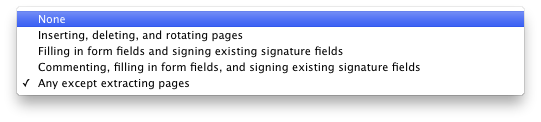
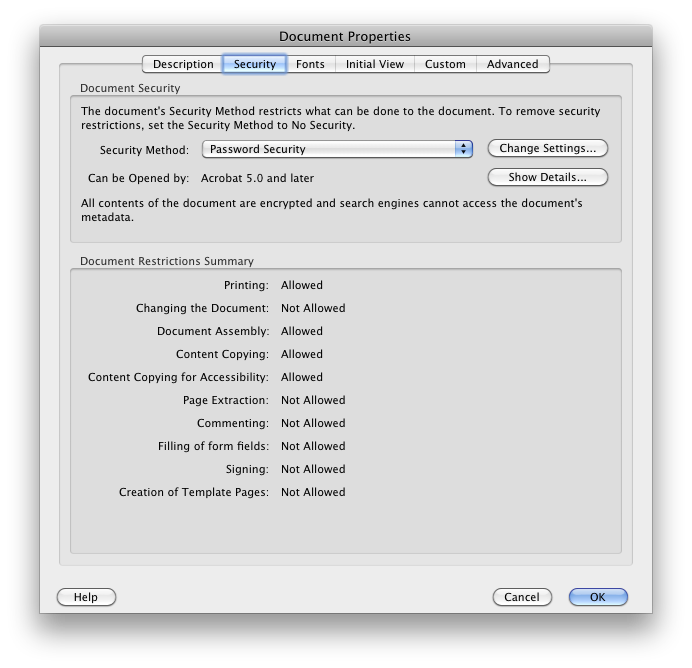
Although the PDF format allows for very granular permissions settings, the Acrobat Pro and InDesign UIs do not. They give the choice of “no protection” or one of four option combinations, which determine the settings of the 10 different permissions.
Options Adobe presents for PDF security
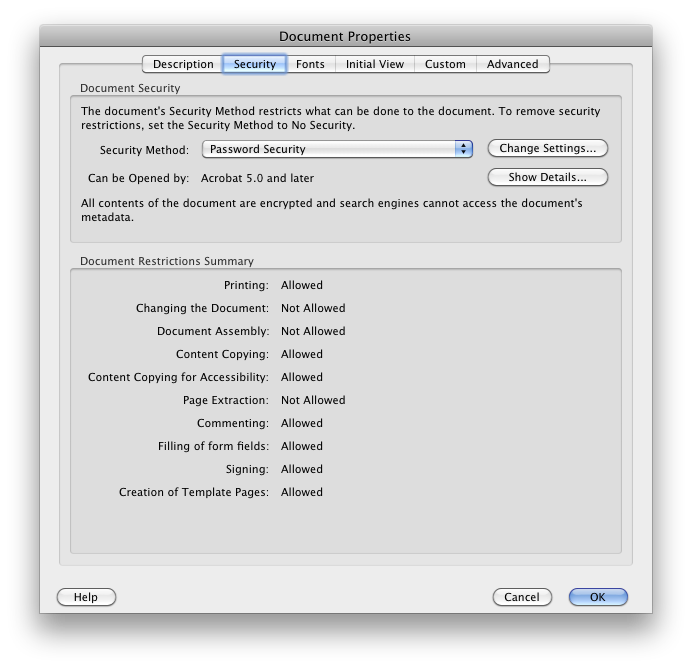
Most publishers of commercial PDFs are going to want to allow commenting, and disallow document modifications. That gives them exactly one choice, which also disallows “document assembly.”
The common choice for security
Nobody is going to go for the “everything but page extraction” option:
Option for “everything but page extraction”
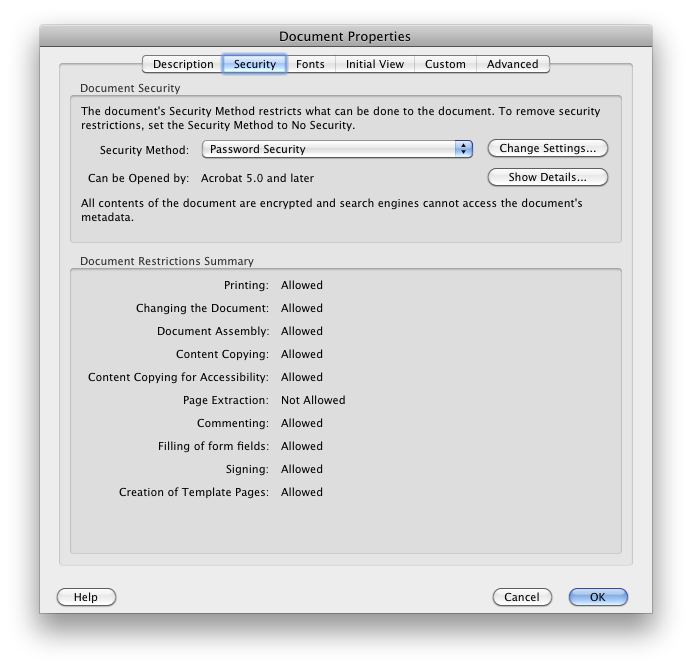
… and short of that, allowing document assembly disallows commenting, for some reason I don’t understand! Perhaps Adobe thought that this would only be used by books going to a professional high-end print production house, who would not need to stick comments on the PDF? Teh broken.
The standard combination that allows “document assembly”
Of course the use case for comments in general is much broader than for imposition, so publishers quite reasonably pick the option that is bugging me.
I see there are third party tools that do allow such granular option choices (e.g. Nitro PDF), but of course they are not so widely used.
Solutions?
Ideally Adobe would change their content creation and Acrobat Pro applications to allow more granular settings of the 10 different functionality permissions in PDFs, without forcing content creators to resort to specialized apps.
We could also fix this by changing the Digital Millenium Copyright Act (DMCA). I gather circumventing an access control mechanism is always illegal unless a specific exemption is carved out for that use. Allowing an affirmative defense for cases where the access control mechanism is circumvented to enable functionality which is either generally allowed by the licensor, or allowed by fair use, would be cool. I’m sure it won’t happen, though, and it would be a long wait.
What else can I do?
I can go to the copyright holders and ask their permission to break the encryption on their PDFs for the purposes of making a fancy book from each, for my personal use. Getting the permission of the copyright holder gets one off the hook for DMCA violation.
(I would also consider it okay to sell such a book to somebody else, if that third party could prove to me that they had licensed the printable PDF as well. But that isn’t my intent in making the books, I really just have personal use in mind.)
I have in fact been doing this, with good luck to date. Kind of a pain to track them down, but authors so far have been really great. They say sure, I can break the encryption on my PDFs for this specific purpose. I guess they quite rightly figure that if I were an evil hacker I wouldn’t be asking nicely about something that I can do easily enough without permission. 🙂
Printing Books?
Hey, I love e-books. I read more than I used to thanks to e-books and my Kindle. But there are some books that for various reasons I would like to have a really nice physical hard copy of. Some of these I have already licensed as a PDF, and that PDF and the license allows me to print it out. So I’d like to do that, and not end up breaking the law just because I want to make a really nice book out of it, not just pages stuck together with glue, like a paperback.
A “signature” is a group of sheets of paper, folded in half, which can then be stitched through the spine of the group (the fold), and also stitched to the other signatures. In traditional offset printing the signature usually starts out as a single huge sheet, folded repeatedly, and trimmed so that the pages are only linked at the spine at not at top and bottom. But if you want to make a fancy book from a PDF, you could just use pages twice the size of the pages of the original PDF document, folded in the middle, to make four pages per sheet. As almost all my originals were 8 1/2″ x 11″, and I have a printer capable printing 11″ x 17″ pages, double-sided, I decided to do that.
Books using sewn signatures instead of glue alone are much sturdier and more resistant to pages coming loose. If the sewn signatures are also sewn to thick cloth tapes which attach to the covers, the book can be extra resistant to the entire book block coming loose from the binding as well. This is the style of binding I am doing in current projects.
More About Imposition
Now, the interesting thing about signatures is that it complicates the positions of your pages. To understand what I mean, try taking three sheets of paper in a stack. Fold the whole set in half to make a booklet. Now start numbering the top right corner of each page. You’ve got 12 numbers.
When you take the stack apart, the first sheet has page 1 on the right half and page 12 on the left. and on the other side it’s pages 2 and 11. Let’s call it 12-1/2-11. The next sheet is 10-3/4-9, and the final sheet is 8-5/6-7. In a full on book there would be multiple signatures, each starting in this kind of sequence. So if I’m printing 8.5×11 pages on 11×17 sheets, I need to rearrange the original pages, and put more than one on each side of a sheet, to get the right pages on the right sheets. Add in possibilities like throwing in some blank or unnumbered pages at the beginning, and multiple signatures, and it can get quite complicated.
Luckily this is an old and fairly well-understood printers’ problem. It’s called “imposition,” which is the art of figuring out which page numbers go where. Of course, in serious offset printing a single sheet might be folded a bunch of times before cutting it apart… that’s really complicated! So there’s imposition software that sorts this out for us. The one I’ve heard the most about is called Quite Imposing and deals with the complexities faced by printers putting many pages on a sheet, among other things. It’s a plug-in to Adobe Acrobat. But it costs $475 USD.
However, for my purposes I only need two pages on each side of the sheet. For that use, I found the amusingly named Cheap Impostor software does everything I need for a fraction of the price of the high end applications. It’s only $35, and it’s shareware so you can try before you buy. I’ve already pumped over a thousand pages through it. The author was quite responsive for tech support, as well. Highly recommended.
Through my day job I am doing a 3-part webcast series on web typgraphy best practices. It is free, and registering once covers all three webcasts (with no obligation to attend).
Part 1: Selecting Fonts. Wed Sep 7, 11 am PST
Part 2: Setting Text, Wed Sep 21, 11 am PST
Part 3: The New Frontier—OpenType typography on the Web, Wed Oct 5, 11 am PST
Recently, a question by Cynthia Batty on the ATypI mailing list led me to do a quick survey on what we call typefaces without serifs. Click here to take survey.
Here are the results of my little survey. There have been over 300 responses. It’s certainly not a random sample, mostly people deeply involved with typography in some way. Interestingly, the results didn’t really vary by expertise level. (The order of the possible answers was randomly varied so as not to influence the answers, btw.)
“sans serif” 68%
“sans-serif” 27%
“sanserif” 2%
other 3%
The most common comments under “other” were that it should be “sans serif” as a noun and “sans-serif” as an adjective (for example, “a sans-serif typeface”). Certainly if the noun form is “sans serif” then standard English usage would dictate that the compound adjective would be hyphenated.
Another common response was that “sans” is an acceptable informal shorthand for “sans serif.”
Finally, it seems that despite a bit of solid support in the UK for “sanserif,” that spelling is neither particularly widely used nor accepted. The Oxford English Dictionary accepts it and dates it back to 1830, and the Oxford University Press, Robert Bringhurst (The Elements of Typographic Style) and eminent professors James Mosley and Michael Twyman all use it, as does typographer and typography author Robin Kinross. I must confess to not much liking “sanserif” myself.
[Edited to correct spelling of “Mosley” and add a little more detail on “sanserif,” and again to add Bringhurst the to list of “sanserif” supporters.]
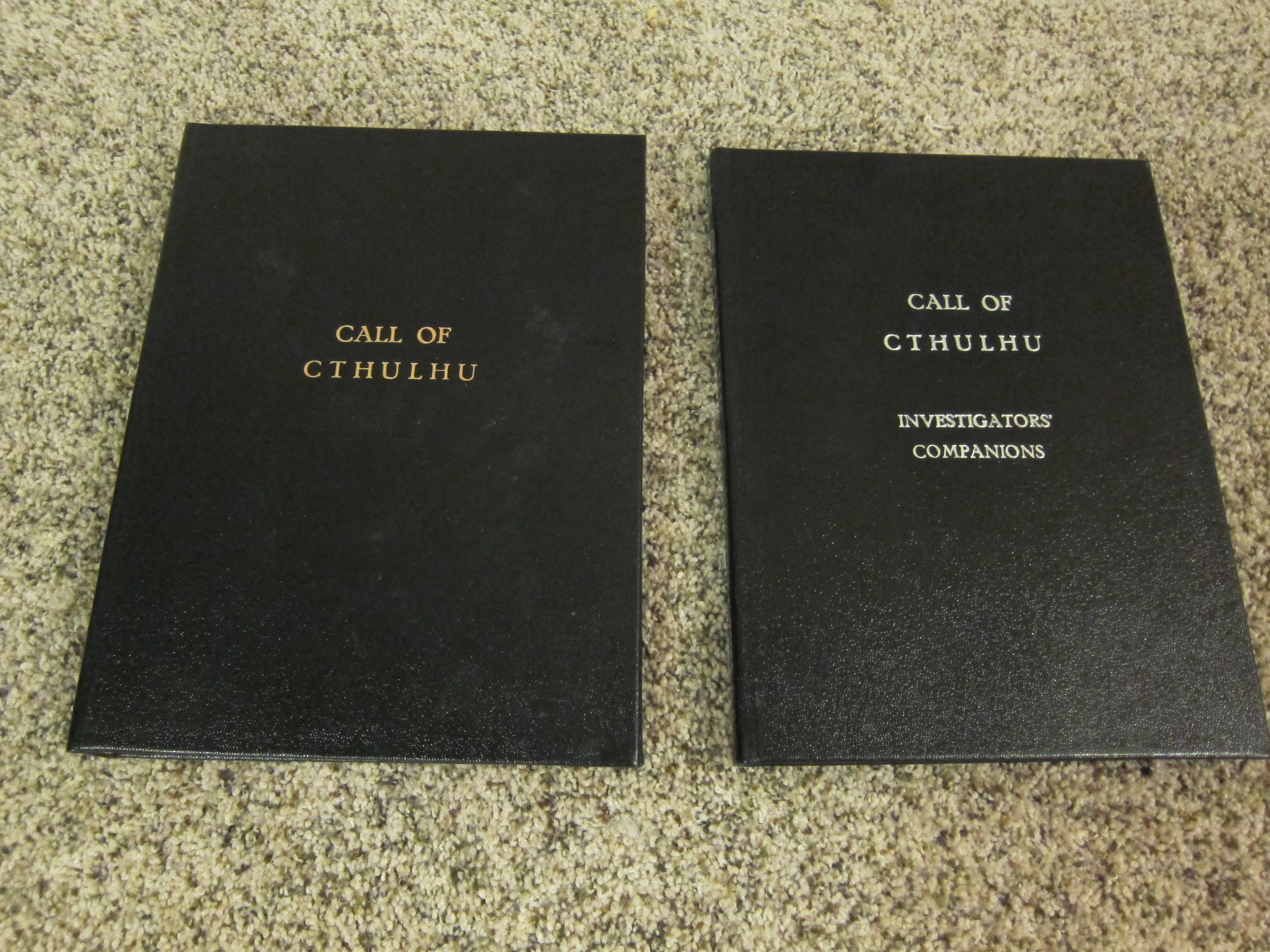
Many years ago, the very first digital font I ever worked on was a version of Hermann Ihlenburg‘s 1892 typeface Columbus, for American Type Founders. I had an interest in it because it was used in the logotype for the Call of Cthulhu roleplaying game, which I had long enjoyed. I never did anything serious with it, both because I did my revival by eye without benefit of scans or good quality originals, and because I didn’t know what I was doing back then. [UPDATE: I funded this typeface on Kickstarter in mid-2012! As of Feb 2013 backers have received pre-release versions of the regular and italic, but they are not “done.”]
Specimen — click for higher-res sample
Ihlenburg is pretty darn obscure, btw. He had the misfortune to be prolific back in the late 19th century, when type designers got very little recognition, and typefaces were just starting to be given unique names. The main available info about him is in a 1993 article David Pankow wrote about Ihlenburg for the American Printing History Association’s journal, on the occasion of an archive of Ihlenberg material being assimilated by the Cary library at RIT (Pankow was then curator of the Cary, and editor of the APHA journal).
Fast forward almost 20 years to 2010-11. While unpacking some boxes, I ran into some photocopies I had made of some good quality type specimens of Columbus, from early ATF specimen books. This was handy, because the earliest ATF book I have is about 1906, and the design had already been dropped by then. A quick search online verified that nobody had done a decent digital version yet. There’s a free version called by its original name, Columbus, by a fellow named Sam Wang, and an $18 commercial font called Beaumarchais from Scriptorium that is particularly awful, worse then the free font. Each has about 100 glyphs.
So I’ve been working on and off on doing a better version from digitized scans. It’s not “done” exactly, but it is already a whole lot better than either of the other versions currently available. I’m still tuning spacing and additional glyphs. I plan about 260 total glyphs, of which about 106 are in good shape right now, including alternate swash caps, which were not done in the previous digital revivals. I am using my old typeface as a placeholder and replacing glyphs as I fix them up.
I did a little bit of work on this font during the type busking at TypeCon New Orleans, and got some good feedback on the eszett and the spacing while I was there (thanks to Gary Munch et al).
I can’t call it Columbus, however: ATF’s trademark lapsed, and Monotype trademarked the same name for a 1992 Patricia Saunders typeface (celebrating the 500th anniversary of Columbus’ famous arrival, while Ihlenburg’s typeface was so named for the 400th anniversary). My previous attempt had for a while been called “Columbine” but that has taken some unfortunate connotations, so for now I’m calling it “Cristoforo,” after the sailor’s first name.
I’m still not sure what I’ll do with it. For now I am licensing it on special one-off terms to a very small handful of companies doing material related to the Call of Cthulhu roleplaying game. Maybe I’ll do a commercial release at some point, who knows?
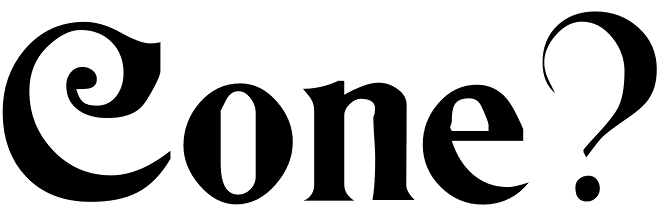
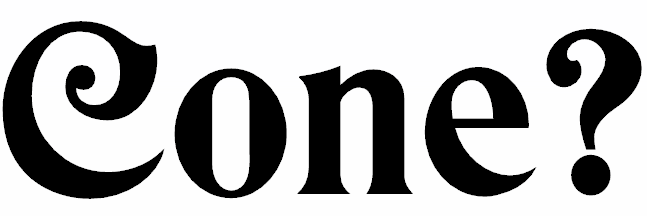
Here are samples of my work-in-progress and its nominal competitors. I’ll leave telling which is which as an exercise for the viewer—make your guess before you hover your cursor over the images, or read the comments.
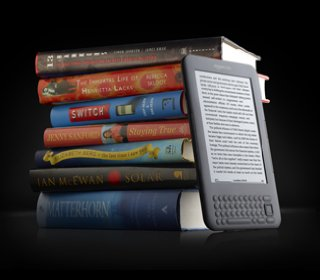
Geez, I thought it might take another year or two, but Amazon says their unit sales of Kindle ebooks (which can be read on the Kindle devices, computers, tablets and smartphones) have passed their unit sales of print books, by 5% for the period since the beginning of April.
Amazon Kindle
Now, of course this is just Amazon and not all retailers, and it’s unit sales rather than dollars, but then again, these figures do not include ebooks Amazon “sells” for free, either. However you slice it, it is still a major milestone. Unlike PC Magazine’s John C Dvorak, I do generally believe the numbers, but unlike Mr Dvorak I also see Kindles on every flight I take, and every bus I ride to and from work. Dvorak makes a big deal of the possibility much of this content is being read on other devices besides Kindles per se, which (as I said last summer) misses the point. The Kindle is good for Amazon because Kindle users are locked into Amazon’s (Kindle-branded) ebook sales, but as long as people buy the Kindle ebooks from Amazon, it’s no skin off Amazon’s nose what device they get read on. The profits are on the content sale, not the reading devices.
I rather expect that retail books as a whole will pass this milestone some time in 2012. We are living in the proverbial interesting times.
paper plus digital $127 for one year, $223 for two years
special offer: paper plus digital for $51 for one year
New York Times:
paper plus digital: $7.40/week, $384.80 per year
digital only: $8.75/week for same level of digital access as a paper subscriber, $455 per year
Time magazine:
$30/yr paper
$36/yr Kindle (without graphics and photos)
Why the craziness? These publishers want me to pay more for the electronic version than the printed one, even though their marginal costs are lower. Publishers are so worried about protecting their paper publishing business that they are hobbling the digital one in ways that make no sense in terms of their overall business and especially in terms of their future.
I didn’t just look up publications that happen to be crazy. The first two are publications I like and enjoy reading and would like to subscribe to. I don’t want the printed versions, which pile up in my home and use up resources for insufficient value (to me, anyway). I want to get the digital versions. I am perfectly willing to pay a “fair” price. Time was the first other big periodical that came to mind, and did not surprise me in having an equally crazed pricing model.
But these sorts of pricing decisions just piss me off, and leave me feeling that the publishers are trying to use digital-only revenue to prop up their failing paper-based businesses. As a would-be digital-only subscriber, I feel exploited. Or I would if I actually gave them my money… which I won’t do under these conditions.
End result of this kind of pricing? Those who continue it will find their market share eaten by those who don’t make that mistake. They will find competitors who either are perfectly willing to let their digital business take over some of their print business, or just don’t have a printed paper business to worry about.
Just as I finished writing this piece, I found an article that sums up the problem nicely:
http://www.betatales.com/2011/04/24/the-word-that-should-be-banned-in-all-media-companies/
Print media businesses are so worried about cannibalization that they are shooting themselves in their heads. I hope it stops before we lose some fine publications, or they become shadows of their former selves.
NOTES:
Yes, I call them “print media businesses,” because that is how they are behaving: at some level they have not figured out that they need to become simply “media businesses.”
Yes, I’m omitting some details and extra options. For exmaple, the NY Times offers a discount on the first two months of digital, and cheaper digital-only options are available from NYT as well, but those offer trimmed-down access choices instead of allowing people access from whatever device they want. Still, the all-digital version that is equivalent to the digital options the print subscriber gets is more expensive, as best as I can tell. Without getting the paper copy, whose price includes home delivery.
Finally, I kept on looking, and sure enough, there are publications that have sane policies in this area. For example:
As always, it will be a great event with tons of fascinating and varied content about fonts, typefaces and typography. Going as a speaker usually nets you free conference admission, which saves you hundreds of dollars. It also gives people you don’t know yet a reason to talk to you about something you are interested in… recommended!
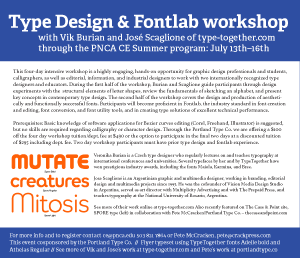
Noted type designers Veronika (“Vik”) Burian and Jose Scaglioné are poised to do a 4-day type design and FontLab workshop right here in Portland, Oregon, in July. It’s being sponsored by the Portland Type Foundry (Pete McCracken), and hosted by the Pacific Northwest College of the Arts.
Type Design & FontLab 4-day workshop
Note that the poster offers two additional options if you work through Portland Type Foundry (details on the poster) and register through them by Thursday April 28: either get a $100 discount on the whole four-day event, or if you already have some type design and FontLab experience you can attend just the last two days for an even cheaper rate.
Check out the poster for more details, or go to the PNCA to register if it’s after April 28 and the poster special is over.
Unfortunately, PNCA is understandably nervous about getting enough registration for such a specialized event, and are considering cancelling the seminar if they don’t get at least a dozen people registered by the end of April! So sign up now to guarantee that it actually happens. Maybe we can at least extend the cut-off until the end of May if it looks close, but no guarantee.
Personally, I’m jazzed to hear that Vik and Jose are coming to town to do this. I’ve been fans of their work for many years, which is why their foundry TypeTogether was among the first I got signed up for the WebINK web fonts service. They are part of a new(er) generation of type designers who have been working with advanced tools and OpenType from very early in their careers.
They also have a particularly international perspective: Vik is based in Prague, Czech Republic, while Jose is in Buenos Aires, Argentina. They met while both working on their MAs in typeface design at the University of Reading in the UK (one of only two such programs in the world). I’ve done a number of guest lectures at the Reading program over the years, and watched as it has turned out a number of outstanding type designers and type tech geeks. Recommended for folks who are really serious about getting into type design, as is the TypeMedia program at the Royal Academy of Art in the The Hague.
BTW, this isn’t the first collaboration between TypeTogether and Portland Type Foundry: Pete McCracken and Vik Burian worked together on a typeface called “Spore” (seen in the poster).
It’s a week late this month, but our monthly Portland Type Tuesday social gathering continues with our fifth gathering. This month it is at:
7 pm
Tuesday, April 12th
Hawthorne Hophouse
4111 SE Hawthorne Boulevard
Portland, OR
I was part of a similar once-a-month gathering in Seattle, that met in a bar in the basement of a bookstore. It was fun and I missed it when I moved to Portland, so I started a monthly get-together here in Portland, which has been meeting since December 2010. I even created a Meetup group this month, sponsored by my employer, Extensis (who do WebINK and Suitcase Fusion).
We usually get together the first Tuesday evening of each month at 7 pm onwards. Folks gather at a local pub, have a brew, snack, and/or meal, talk about things typographic, and sometimes bring an item of interest for show and tell. There are always one or two new people, and a large handful who have met before.
Please join us if you are interested in getting together to talk about fonts and typography, and perhaps share typographic items of interest (not a requirement to bring something!). Because it’s at a bar, you need to be over 21, though if a few people tell us this is an issue we could try a café or something instead. Other than that, people of all ages, genders and aesthetic backgrounds are welcome.
I will be the fellow in the green hat and red mad scientist glasses. There might be more books and such kicking around our party than you usually see in a bar. 🙂 See you there!